ATA Magazine
Her happy place
Suneet Kharey on discovering the teacher within
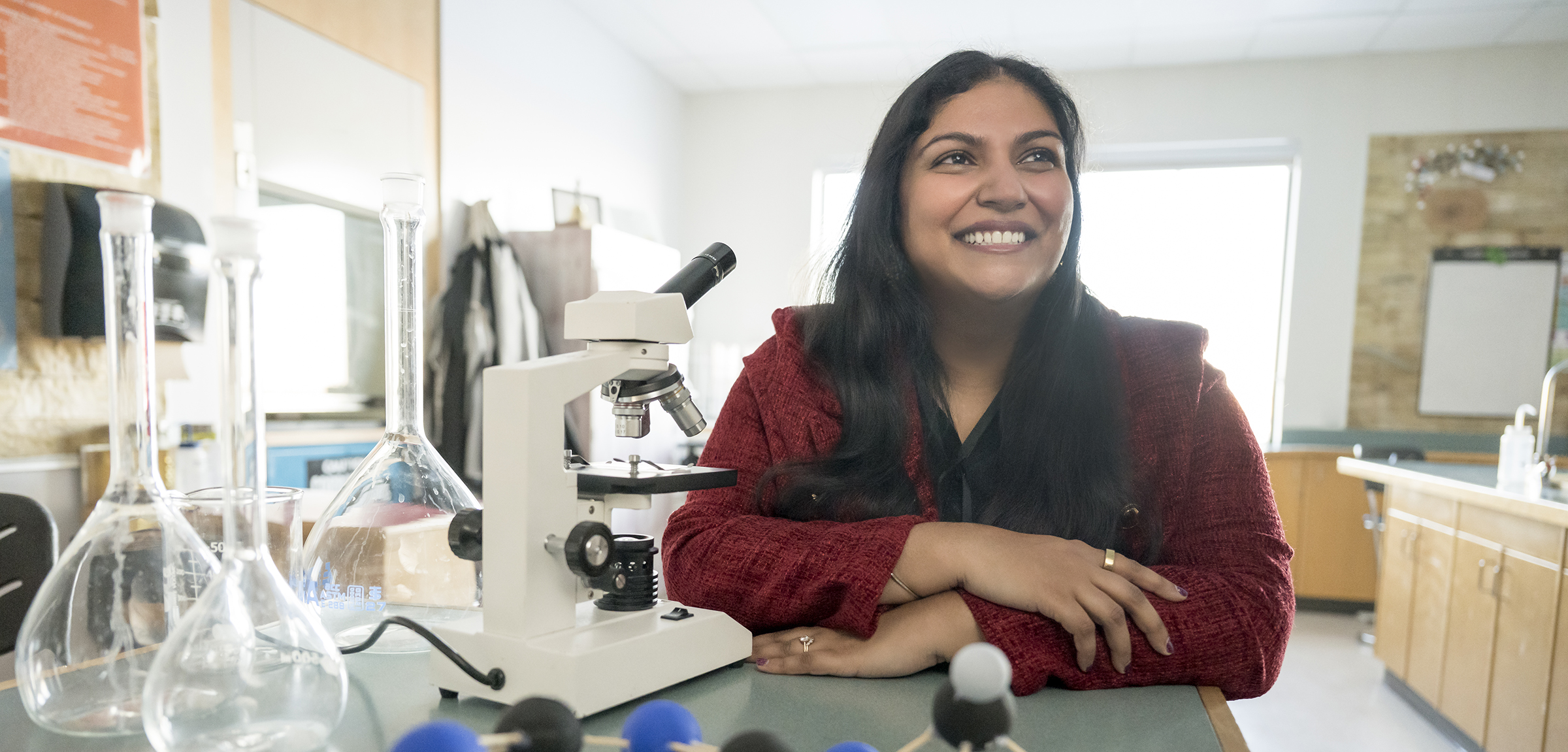
As a young child, Suneet Kharey would spend weekend afternoons creating a school of her own.
The classroom: her playroom.
The students: a cuddly menagerie of stuffed animals, and occasionally her mom, whom Kharey would quiz to ensure she met the requisite learning objectives.
“To me, that was the most fun activity that I could do,” Kharey recalls with a laugh. “I should mention that I was an only child.”
Now a teacher at Chestermere High School, Kharey sees that she had the hallmarks of a teacher all along. It just took her awhile to fully embrace it.
Where to?
Kharey grew up in Calgary, where her parents, immigrants from India, instilled in her the value of education. Post-secondary studies were an expectation.
In high school, she gravitated toward the sciences and initially set her sights on dentistry, starting a biology degree at the University of Lethbridge (U of L). Even as she began to question that path due to a lack of fulfillment, she stayed in the sciences, joining the U of L premed club and the iGEM competition team. This experience made her feel like she could make a difference and spurred an interest in bioethics.
Driven by that interest, Kharey completed her biology degree and began studying philosophy as a step toward law school, before stepping back to consider where her skills and interests could make the most meaningful difference.
Unsure of her next step, she turned to a trusted academic advisor, who—to Kharey’s surprise—suggested she take the U of L’s Orientation to Teaching course. After all, she already had experience with the university’s science camps.
“I’d always respected teachers, but I never pictured myself as one, until I saw that I could be the representation I wished I’d had growing up.” She took a chance, signed up for the course and soon found herself in a classroom, loving every minute of it. Nice job, teacher.
Right from the start, Kharey understood that teaching is about more than content.
“Teaching is really all about relationships,” Kharey says, “Even now, students come up to me and say they might not like math, but they’ll do it for me, because we’ve built that connection.”
Her mentor teacher, Tim Folkersen, quickly recognized Kharey’s ability to connect with students. In particular, he recalls how strongly one student who had lacked confidence in math responded to Kharey.
“This girl had to move, and I remember she was devastated, just devastated, because she wasn’t going to get to have Suneet as her teacher anymore. She had only been teaching a week, maybe two,” Folkersen says. “I said to Suneet, ‘Good job. Nice job, teacher.’”
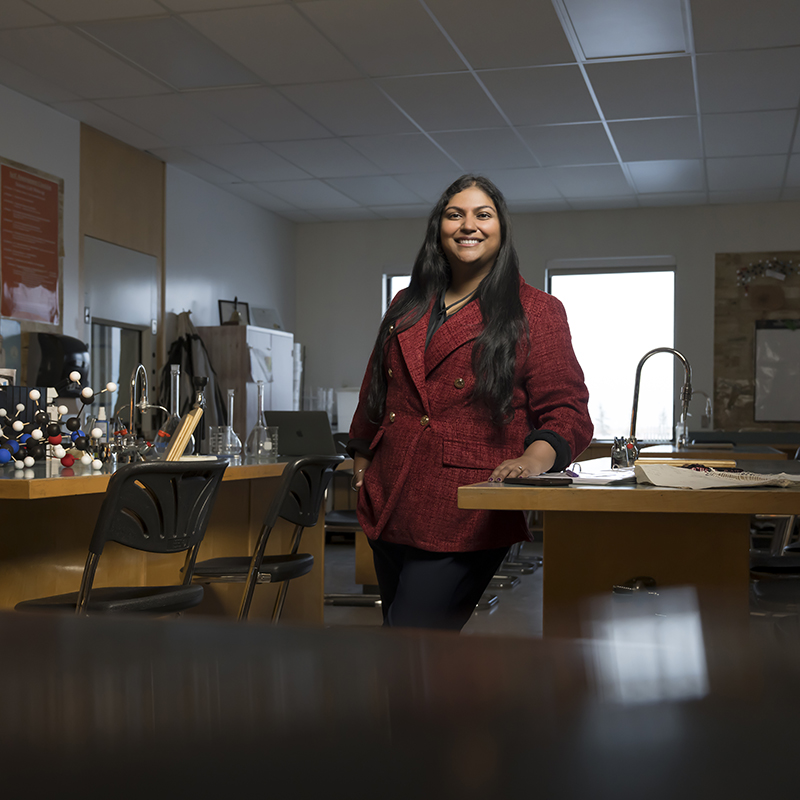
Kharey was and wasn’t surprised at her ability to connect with students. She had always loved math and science, and she revelled in sharing that joy with the next generation of learners. Somehow, the doubt that had crept in when she was pursuing dentistry or law wasn’t there this time. She knew she was meant to be in the classroom, reaching these students.
“This was a pivotal moment for me,” Kharey says. “I thought that just because I haven’t had teachers who look like me doesn’t mean I can’t be that teacher for someone else.”
Always adding
For Kharey, doubt looks different now. She knows that teaching is the place for her, but she hasn’t always seen many people who look like her in the small communities where she has taught.
“I’m well educated—almost 10 years of university since I didn’t know what I wanted to do—but when someone refers to me as a ‘diversity hire,’ I start to question everything.”
In these moments, though, Kharey reminds herself that the work she does is important, that the relationships she is building with her students and the entire school community can make an impact.
“As a second-generation Indo-Canadian, it’s about understanding the value of diversity and representation in education and ensuring that all students feel empowered to achieve their full potential,” Kharey says.
She believes that her presence can help students celebrate their own value and navigate challenges within and beyond the classroom.
Each success Kharey shares can help students dream. Each roadblock can let them know they are not alone. She wants her students to feel safe to try new things, even if it means failing. She wants them to know that their education will always be there for them, even if it takes them time to find their way.
And Kharey has no regrets about taking her time to find teaching.
“My parents have always said education is one thing no one can ever take away from you. It always adds. So, this is where I’m meant to be.”
Meet and Greet with Suneet Kharey
What do you remember most about your first year as a teacher?
I started teaching during COVID-19, when learning was entirely online. It forced me to be intentional about relationship-building in a moment when students were isolated and overwhelmed. That experience fundamentally shaped my practice and continues to inform how I support students today.
Your journey has taken you from biology to law to teaching. Where next?
I completed my master’s degree in critical studies in May 2025, and I plan to stay in education. Teaching is where my background in science and my interest in critical thinking and equity come together in a way that feels meaningful and sustainable. I want to be more involved in shaping the profession through ATA work, supporting preservice teachers and contributing to honest conversations about curriculum, power and whose knowledge is valued in schools.
What do you do to unwind?
I like quieter, creative ways of slowing down. I paint, garden, read, listen to podcasts, and spend as much time as I can in the mountains.
Got an idea? In Profile features an interesting teacher in each issue of the ATA Magazine. If you know of a teacher who would be a good profile subject, please contact managing editor Cory Hare at cory.hare@ata.ab.ca.