
Pulse survey results raise red flags
Classroom complexity and government disrespect have teachers feeling stressed
Alberta teachers are reporting extreme levels of stress and pessimism due to increasing classroom complexity and recent government decisions.
The ATA’s latest pulse survey of nearly 6,000 members found that 95 per cent reported feeling stressed and 94 per cent were pessimistic about the future of the teaching profession. Respondents pointed to two key sources of their emotional turmoil: increasing classroom complexity and the government’s use of the notwithstanding clause to end the teachers’ strike.
“At the personal level, teacher well-being has deteriorated to alarming levels,” the report states. “These metrics paint a picture of a profoundly fatigued and demoralized workforce struggling to find solid ground.”
Qualitative comments in the report describe widespread moral distress, burnout and despair. Many teachers, across ages and experience, expressed a sense of hopelessness and even an intent to leave the profession.
“I am burned out. I come home and want to sleep or cry. I don’t have it in me anymore,” wrote one survey respondent.
“Everyone seems especially depleted since the strike and the devastating results,” wrote another.
The ATA is calling for real solutions that lessen the burden on teachers and school leaders. ATA president Jason Schilling said this can be done by adding more teachers to reduce class sizes, providing more educational assistants to support with complexity, placing a counsellor in every school, and by providing access to mental health workers and other wraparound services like speech and physiotherapy.
“The use of the notwithstanding clause along with the increasing complexity in classrooms has demoralized teachers and left schools scrambling to meet the diverse needs of their students,” said Schilling. “It’s time for real solutions.”
Complexity index unveiled
This latest research report makes use of an online classroom complexity index tool designed by ATA researcher Phil McRae to quantify the additional workload generated by complex student needs. To apply the index, a number is assigned to students of various levels of complexity to reflect the amount of additional time they would require compared to a “typical” learner. For example, while a typical learner counts as one student, a gifted student would count as 1.25 students because they generally require 25 per cent more teacher time. In applying the index, a student with severe needs is counted as two students.
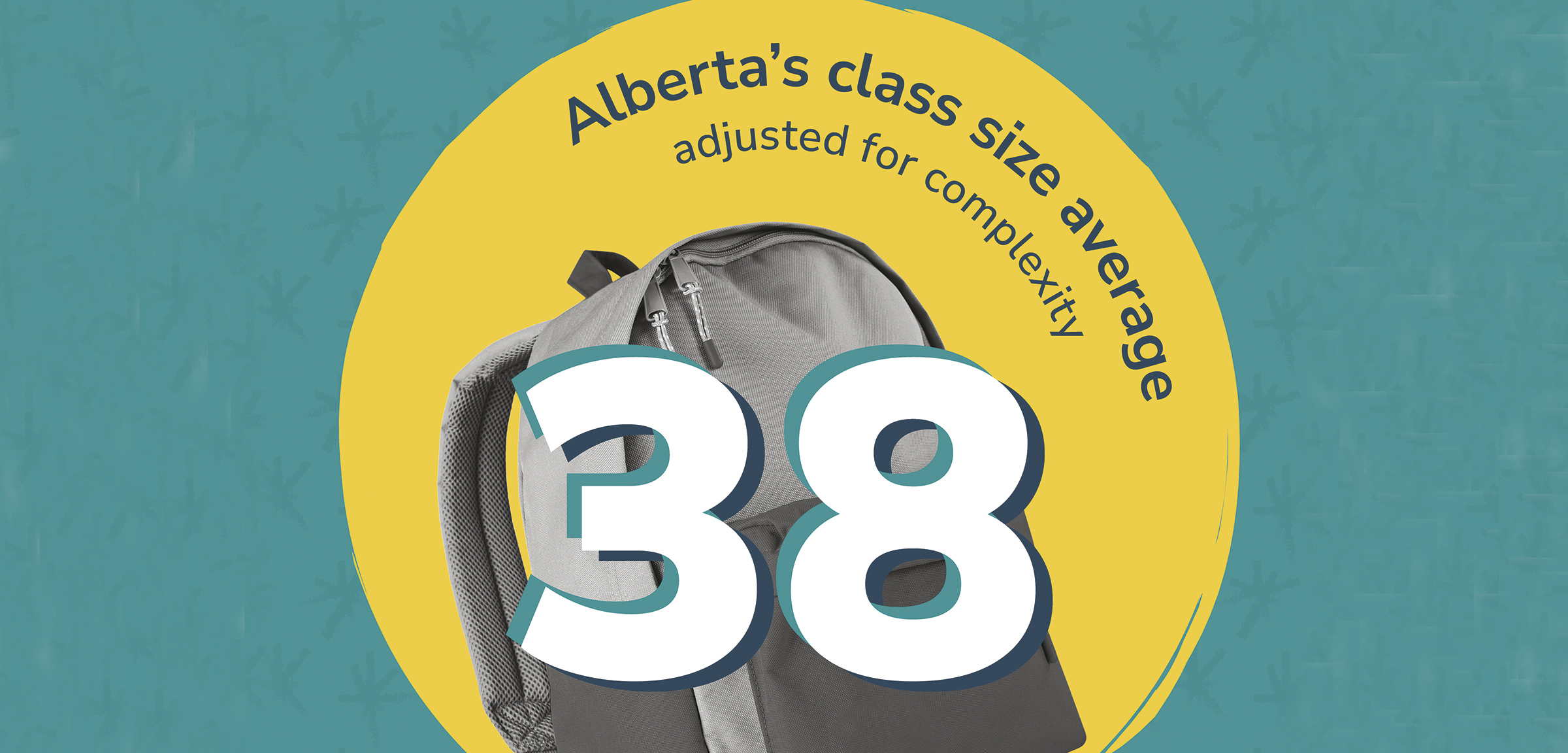
Based on class size and complexity data gathered through the survey, the average indexed class size in Alberta was 38. That is, when various complexities are factored in, the average teacher workload is the equivalent of 38 typical students.
“Classroom complexity is the real instructional load for teachers,” McRae said. “It is measured by both the class size plus the full range and intensity of student needs that require extra planning, supports and coordination.”
Personalized Classroom Complexity Index
This index estimates the amount of teacher attention students require based on their level of need and produces an indexed class size score that estimates a teacher’s actual workload.
| Student type | Index score |
| Typical | 1 |
| Gifted | 1.25 |
| Needs individualized supports | 1.5 |
| Has mild to moderate specialized needs | 1.5 |
| New to the instructional language | 1.5 |
| Severe or multiple specialized needs | 2 |
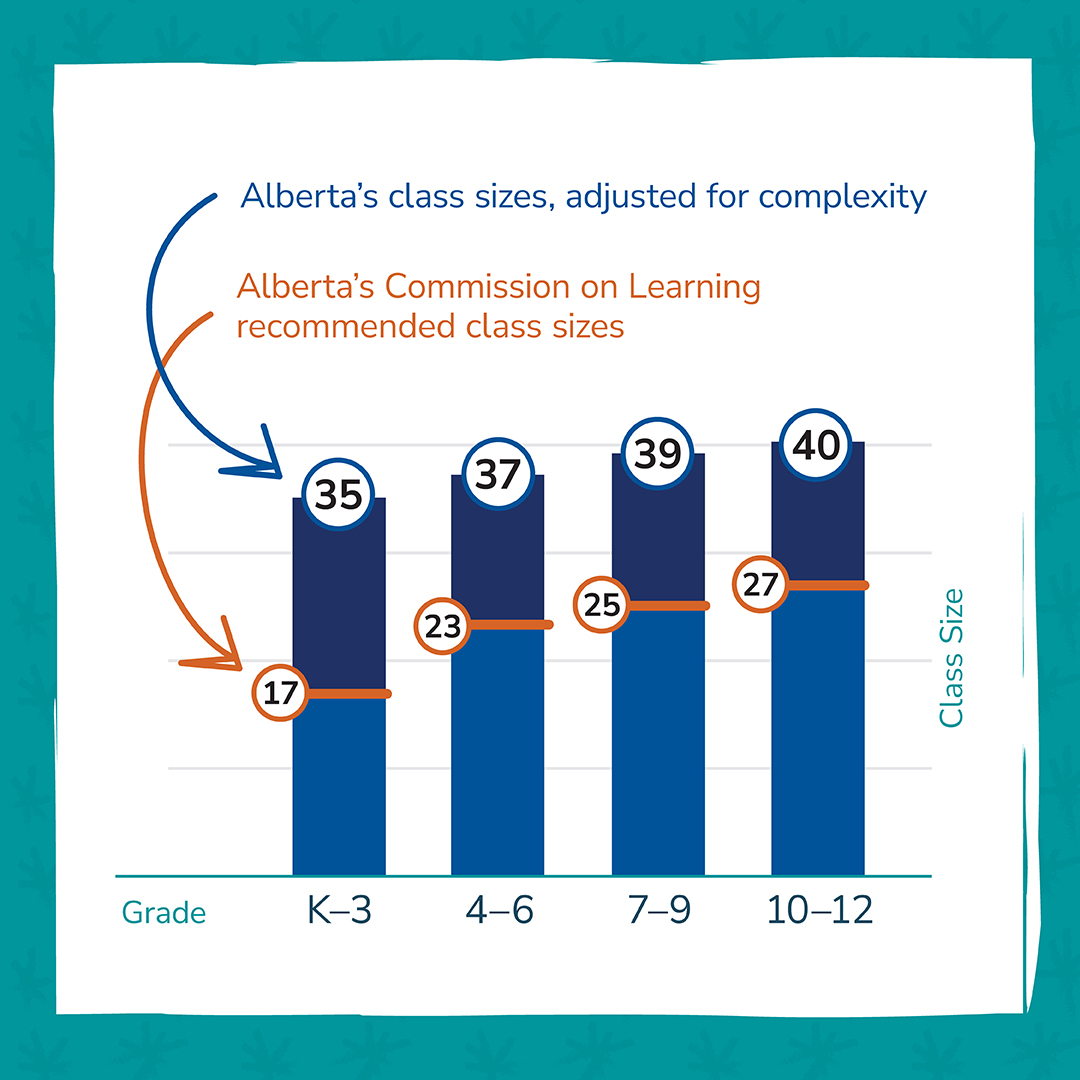
Here is a breakdown of the complexity index by grade level.
| Grade Level | Average indexed class size |
| Overall | 38 |
| K-3 | 35 |
| 4-6 | 37 |
| 7-9 | 39 |
| 10-12 | 40 |
| Online/blended | 50 |
| Survey Response | % of respondents |
| Feel stressed | 95 |
| Feel pessimistic about the future of the profession | 94 |
| View the use of the notwithstanding clause (Bill 2) as detrimental | 91 |
| Concerned about curriculum changes | 74 |
| Concerned about proposed funding model changes | 54 |
| Feel their views are respected by the provincial government | 13 |
A profession in crisis
The well-being of teachers and school leaders remains at crisis levels.
Teaching the ‘normal’ child has taken a back seat. Many students need individual or small cluster supports that I, on my own, cannot provide.
Students could be in specialized settings but there are no spots. Inclusion without support is not safe, and it is not working.
I spend my lunch break prepping or meeting students. I never leave my classroom. I have never worked harder in my life.
Find it online
The ATA’s fall 2025 pulse survey polled more than 5,700 teachers from November 21 to December 5.
Find the report online at https://abteach.cc/Fall2025Pulse.