
ATA News
Advancing women and girls in science - Why does it still matter?
Each year, the International Day of Women and Girls in Science (marked annually on Feb. 11) invites us to celebrate progress: more women and girls are choosing STEM (science, technology, engineering and math), and more organizations are addressing gender equity. As a learning leader with the Calgary Board of Education (CBE), someone who has worked professionally in laboratories, and an advocate who supports women and gender-nonconforming youth in various STEM settings, I truly believe in advancing women and girls in science.
Girls are not lacking interest or ability in science; they are lacking the feeling that they belong there long-term.
My commitment to this work is deeply personal. Despite being accepted into medical school, my mother could not attend because she lived in a society that did not value educating girls. Determined that her daughters would not be held back, she supported my sister and me when we pursued science. My sister, Sarah Waseem, is now an engineer and the recipient of a Young Women in Energy award. When asked what advice she would give to women and girls pursuing science, her reply was simple yet powerful: “Look at everything as an opportunity. An opportunity to try something new and explore our interests. An opportunity to adapt when things around us change. Even what we call ‘setbacks’ are opportunities to learn and grow. Never be afraid of taking on opportunities, for you never know where they might lead.”
Equally inspiring is that my mother did not abandon her own education. While raising children, she pursued a computer information systems degree and an MBA and now works as a financial systems supervisor with the Calgary Board of Education (CBE). Her story is a testament to why this work is not just about access, but also about ensuring systems allow women to return, persist and lead at any stage in life.
In my roles as a math and science teacher with the CBE and as a coordinator for the Canadian Association for Girls in Science (CAGIS) Calgary, I see clearly that creating cultures that highlight women role models—and where girls are introduced to and challenged in STEM—not only increases knowledge and confidence, but also fosters a sense of belonging. What I observe repeatedly is that girls are not lacking interest or ability in science; they are lacking the feeling that they belong there long-term. Subtle messaging adds up—it might be as simple as who gets called on to answer questions or lead experiments—and it shapes how girls view themselves in science. By being mindful about inclusion, we help girls better envision a future in STEM. While this may seem like special treatment, it is, in reality, the intentional removal of barriers that should never have existed in the first place. It is permission for girls’ talents to thrive alongside boys’ talents, rather than behind them.
I have also seen how women’s presence in leadership facilitates STEM programming for girls. It was a woman principal who supported my colleague and me a few years ago in securing grants to organize STEM field trips for girls. Proposing the idea felt natural, as my principal already understood its importance. This experience is one of the reasons I promote women in leadership as part of the provincial ATA’s and my local’s Women in Leadership committees, and why it has become part of my doctoral focus. We need to create environments where women teachers and school leaders can experience success without having to constantly prove themselves in ways their male colleagues do not.
At the same time, I want to emphasize that lifting women up does not mean putting men down. We have amazing male allies, my father being one of them. He has been our biggest supporter and a role model for my wonderful brother. His experience also demonstrated how gender equity benefits men’s well-being as well. When he was the sole breadwinner, he had far less time with his family than when he and my mother both worked and shared home life together.
While the progress we have made is real, the work is far from finished. I remain deeply grateful that I have the opportunity to encourage women and girls in the same way my parents have always encouraged me.
Sana Waseem (Ed.D. candidate) is an award-winning education professional with over 13 years of experience in multiple settings. She currently works as a learning leader for the CBE, and serves on provincial and local ATA committees. With an unwavering dedication to promoting diversity, Waseem has made diversity in leadership a focus of her doctoral research at the University of Calgary.
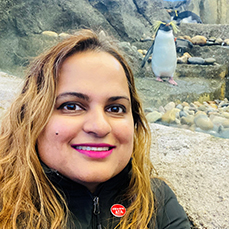
Sana Waseem
Learning leader, CTF, Technology and Library