ATA News
A vote of nonconfidence
Question: My local’s council of school representatives passed a “motion of nonconfidence” in the Association’s provincial leadership. What happens now?
Answer: Not much.
But before I get into this more deeply, full disclosure: as executive secretary, I am a table officer of the Association, although not a member of Provincial Executive Council. As such, I am swept up by, and even explicitly named in, some of the recently passed nonconfidence motions. As always, though, I will endeavor to be as accurate as I can in providing this response. Now back to the answer.
Not much.
A motion or vote of nonconfidence is a formal expression by a representative body that it does not support its current executive, conveying that the leadership is unfit to hold office because of some impropriety or perceived failure. In parliamentary systems, such as we have governing this country, the passage of a vote of nonconfidence, by convention, forces the immediate resignation of the cabinet and, typically, the dissolution of parliament followed by a general election. Note that it’s not only the leaders who have to face voters; it’s every elected member of parliament. (Homework assignment for keeners, look up “King–Byng affair.”)
However, the Association and its subgroups are not constituted as parliamentary structures and, in any event, a vote of a subgroup (such as a local) established by the provincial Association is not binding upon the provincial association or on Provincial Executive Council. The terms of office and the election/selection processes of the Provincial Executive Council and the table officers who form its executive are set out explicitly in the bylaws of the Association and in the Teaching Profession Act, a piece of provincial legislation. No provision exists for votes of confidence in either.
The argument might be made that a vote of nonconfidence by a local has symbolic weight and that the provincial office holders who are deemed to have lost the confidence of those they are supposed to serve are under a moral obligation to resign their positions. While I appreciate that the votes reflect the sincere sentiments of the participating representatives and locals, the votes themselves do not set out in any clear way how those to whom they are directed failed or erred in their duty or conduct. I understand that teachers are livid at the outcome of the strike—certainly the leadership of the Association is—but the passage of Bill 2, the Back to School Act, effectively stripped the Association and its leadership of the ability to further shape that outcome. The blame for this lies squarely with the provincial government, and the Association is using every legal avenue to challenge the legislation.
Some have argued that the Association should have called upon teachers to defy the legislation and refuse to return to their classrooms. I can assure you that this possibility was carefully considered but, ultimately, rejected by a majority vote of Provincial Executive Council. In making its decision, Council weighed the cost and consequences for individual members against the limited prospect for such action achieving a better outcome. Also, a call for illegal action could potentially have divided the membership and invited further sanctions. You might well disagree with that decision, but principled disagreement on a hard question is not evidence of malfeasance or error, and is insufficient justification for a vote of nonconfidence.
Even if they have no formal effect, nonconfidence votes are not without consequences, mostly negative. They have the effect of personalizing policy discussions in unhelpful ways. Instead of constructively engaging difficult issues, they denigrate, alienate and demoralize the very individuals who are working to achieve better outcomes for teachers. When directed inward, nonconfidence votes sow division and undermine the credibility of those charged with speaking to external audiences.
When directed externally, a vote of nonconfidence, rather than advancing a cause, can undermine any possibility of progress. For example, in 2014 and 2021, the annual representative assemblies of the day passed nonconfidence motions in education ministers Jeff Johnson and Adriana LaGrange respectively. Both were quite delighted. Not only did the passage of the resolutions prove to their party’s base that the ministers were standing up to the big bad union, they provided these ministers and their departments with a ready-made excuse to freeze the Association out of any representation or engagement for several years afterwards. The ministers’ position was clear: why would they talk or listen to an organization that has no confidence in them? However legitimate the motions may have been from teachers’ perspective, if the intention was to move the government to address teachers’ concerns, the effect was entirely the opposite.
I can tell you that my fellow table officers and members of Council have felt the emotional impact of these votes and have weighed individually how we will respond. We have also been frustrated, because when it comes to providing us with guidance and a path forward for the teachers we represent or serve, they do little good and, well, accomplish…not much.
Questions for consideration in this column are welcome. Please address them to Dennis Theobald at dennis.theobald@ata.ab.ca.

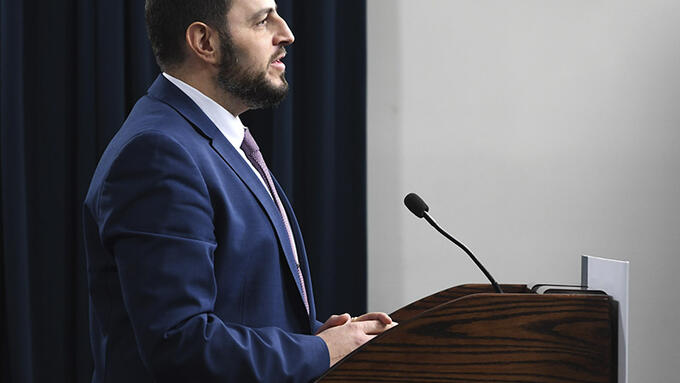
Dennis Theobald
ATA Executive Secretary