ATA News
"Solidarity does not mean sameness"
ATA president delivers powerful speech calling for renewed unity
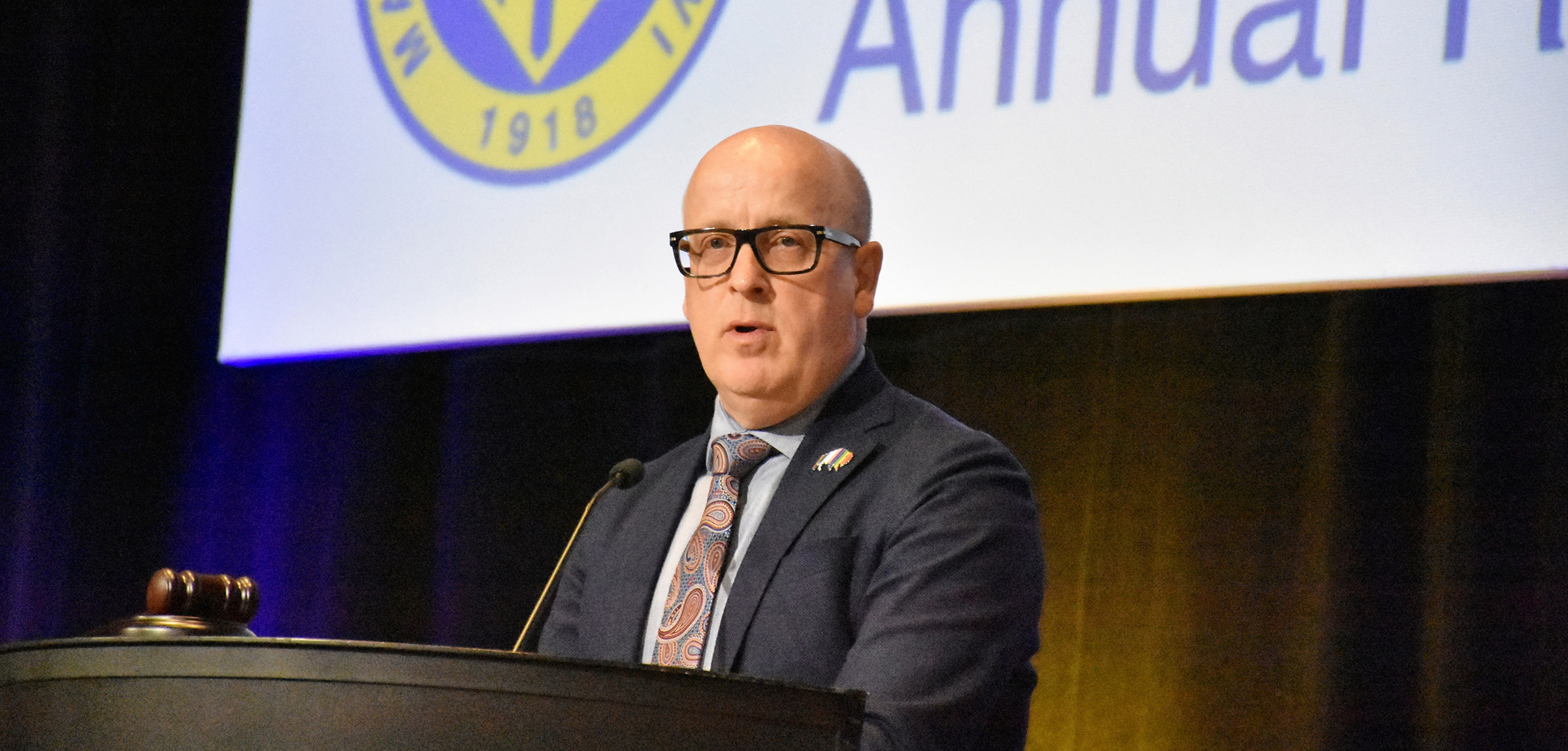
Solidarity within the teaching profession is about choosing to listen to each other, to stand together and to defend public education to build a better future for the province, even in difficult times. That was the core message of ATA president Jason Schilling’s address at the 2026 Annual Representative Assembly (ARA), held over the May long weekend in Calgary.
Speaking to more than 400 teacher–delegates from across Alberta, Schilling began with a reminder of what grounds teaching: the classroom. He described teachers’ connection to that space and their students, and how the work of teachers—himself included—has carried on despite challenging conditions.
“Not because it was easy, not because the conditions were ideal, but because of what I believe. A belief in honesty, in justice. A belief that I can make a difference.”
Strongest together
Schilling then reflected on the strength and solidarity shown by Alberta teachers over the past year, specifically during an historic provincewide strike that shone a spotlight on strains being placed on the public education system. He thanked Alberta’s teachers and school leaders for their courage, professionalism and commitment to their students, saying that they proved that the teaching profession will not be silenced.
Schilling also acknowledged parents and community members for their support of teachers, as well as the leadership shown by ATA locals, Provincial Executive Council and ATA staff during the strike.
“This community, this Association, is bigger than any one of us. As an Association we should be proud of our diversity, our strength and our values. When it mattered most, teachers showed up and stood up.”
At the same time, Schilling acknowledged the strain felt across the profession following the labour action. He said that, even with their shared concerns and values, teachers experience different realities and hold different perspectives. Speaking to the tensions this can create, Schilling called upon teachers to find a way to come together.
“Whatever perspective we bring to that moment, whatever complex emotions we carry—anger, frustration, disappointment, pride—it left us with a truth we cannot afford to forget: we are strongest when we act together, and we are weakest if we turn on each other.”
Rather than dismissing differing perspectives and feelings, the president encouraged teachers to use them constructively and pair anger with hope.
“Not the kind of hope where we pretend everything is fine—but the kind teachers practice every day.…The hope that refuses to give up on students and ourselves, even when the system makes it harder than it should be.”
201 days later
During his speech, Schilling observed that it had been 201 days since teachers were stripped of their charter rights through the government’s passing of Bill 2, the Back to School Act. Remarking on this and other legislation affecting the profession, he called on teachers to consider how to constructively move forward together. This includes, he said, building bridges so all members feel seen and heard and recognizing that solidarity does not mean sameness.
“It means listening, holding space for our members’ diversity while also holding firm to our values to ensure that every member can see themselves in the path forward,” he said.
With three days of debate ahead, Schilling encouraged delegates to bring forward their voices, ideas and concerns while focusing on members’ shared goals and strengthening Alberta’s teaching profession and its Association.
“What we build here might not be perfect…but it must be united. It must be grounded in the values that brought us into this profession in the first place.”
Schilling closed his address by focusing back on the classroom and reminding delegates of the strength of teachers’ collective power through and beyond ARA.
“Let this assembly be remembered not only for the debates we had or the challenges we faced, but for the choices we collectively made to listen, to stay united, to defend public education and each other,” he said, “And to keep building a future worthy of the students and families we serve.”