ATA Magazine
When machines pretend to care
Research insights
No technological product or platform can replace the trust, care and professional judgment at the heart of teaching and the lifeblood of our societies.
—David Edwards, General Secretary of Education International
In May 2026, Alberta teachers confronted a question at their Annual Representative Assembly (ARA) that no other education system around the world had yet addressed: What happens when AI stops acting like a tool and starts presenting itself as a relationship?
Protecting the student–teacher relationship
Anthropomorphic AI is not simply another name for general purpose tools such as ChatGPT, Gemini, Grok or Claude. AI companions on platforms such as Character.AI, Replika or Nomi are designed to have humanlike personas, empathy-like responses, friendly personalities and emotionally responsive conversations.
These systems are designed to simulate human companionship, friendship, counselling or intimacy. In an age of widespread loneliness, their appeal lies in the promise of a frictionless, caring connection, which is always available, always agreeable and engineered by the AI system to sustain engagement. By using patterns in human language and emotional cues as performative empathy, the systems can capture attention, prolong interaction and cultivate attachment. They do not care, but they are designed to appear as though they do.
That design creates a serious concern for children and youth in K–12 schools. When a machine appears caring and endlessly responsive, young people may attach to it in ways they do not fully understand. At a time when we are faced with increasing social fragmentation and declining human connection, students may be especially vulnerable to systems optimized for persuasion, dependency and prolonged interaction (at any time, place or pace).
At the Alberta Teachers’ Association’s democratic assembly in May 2026, delegates representing all 51,000 Alberta teachers passed a resolution that drew a clear ethical boundary around a specific subset of AI known as anthropomorphic AI—systems intentionally built to simulate human relationships, identities and emotional presence.
The resolution, which is now official Association policy, stated:
Be it resolved that anthropomorphic artificial intelligence (AI) tools, including AI companions and other AI systems designed specifically to simulate friendship, counselling or intimate relationships, not be deployed or introduced into any Alberta K–12 learning environments or support settings.
Our schools must never become testing grounds for synthetic companions that attempt to simulate affection and manufacture human-level trust. The teaching profession, therefore, draws a clear “human” line by prohibiting relational AI companions in K–12 learning and student-support settings while establishing strict conditions for other anthropomorphic simulations. In doing so, we are protecting the teacher and student relationship and unequivocally stating that technology should never replace that human bond in the highly relational spaces of teaching and learning.
The resolution is not a rejection of artificial intelligence as one of the defining forces of what is a fourth industrial revolution, nor does it preclude responsible use of AI systems or tools from supporting student learning or teacher professional growth. It is a necessary safeguard around a specific subset of AI systems designed to create affection and, ultimately, emotional dependence.
Truth, consent and instructional context
At ARA 2026, Alberta teachers also discussed the risks of AI simulations that impersonate real people. Hyper-realistic versions of scientists, authors, artists, political leaders and other historical figures can now be generated quickly. They can converse in the first person and create the impression that a student is speaking directly with someone from the past.
The novelty may be engaging, but AI does not bring a historical figure back to life. It fills gaps, invents dialogue, uses emotional cues, recognizes patterns and constructs responses that may sound authentic while containing inaccuracies, distortions or fabricated information. In an era of misinformation and disinformation, unlabelled simulations can blur the line between evidence, interpretation and fiction. They can rewrite history; reinforce bias; and undermine the trusted, authoritative role of teachers.
The decisions made now will shape the human boundaries of education for years to come, not only in Alberta and Canada but for teachers and school leaders around the world.
A policy adopted by delegates at ARA 2026 allows for thoughtful, instructional use of AI simulations or impersonations with two safeguards: historical simulations must be clearly labelled as nonliving entities, and they must be used in an appropriate instructional context. Teachers provide the evidence, perspective and critical analysis that technology cannot. AI may help students explore history, but it must never be permitted to redefine it or, in an age of misinformation and disinformation, distort it.
Delegates also adopted a parallel policy that applies to living people, as AI can now easily reproduce with striking accuracy a person’s voice, image, likeness, elements of personality, communication style and unique mannerisms. When an AI simulation uses the identity of a respected teacher, Elder, scientist, artist, community member or public figure, students may naturally transfer credibility and trust to whatever the system says. This “trust” can be undermined with an inaccurate or intentionally altered AI simulation of a living person.
No person’s identity should be replicated and deployed in schools without their independent, full and informed consent. People have a right to determine how their voice, likeness and identity are used, to understand how a simulation will function and to know how it will be presented to students. Consent, transparency, teacher oversight and critical discussion are essential. AI should never be allowed to borrow a person’s identity without permission.
The two resolutions adopted at ARA 2026 are as follows:
Simulations or impersonations of historical figures
Be it resolved that artificial intelligence simulations or impersonations of historical figures require clear labelling as nonliving entities and that they only be used within an appropriate instructional context.
Simulations or impersonations of living people
Be it resolved that independent and informed consent be obtained for any artificial intelligence simulations or impersonations of living people and that they only be used within an appropriate instructional context.
| AI policy for teachers and classrooms |
|---|
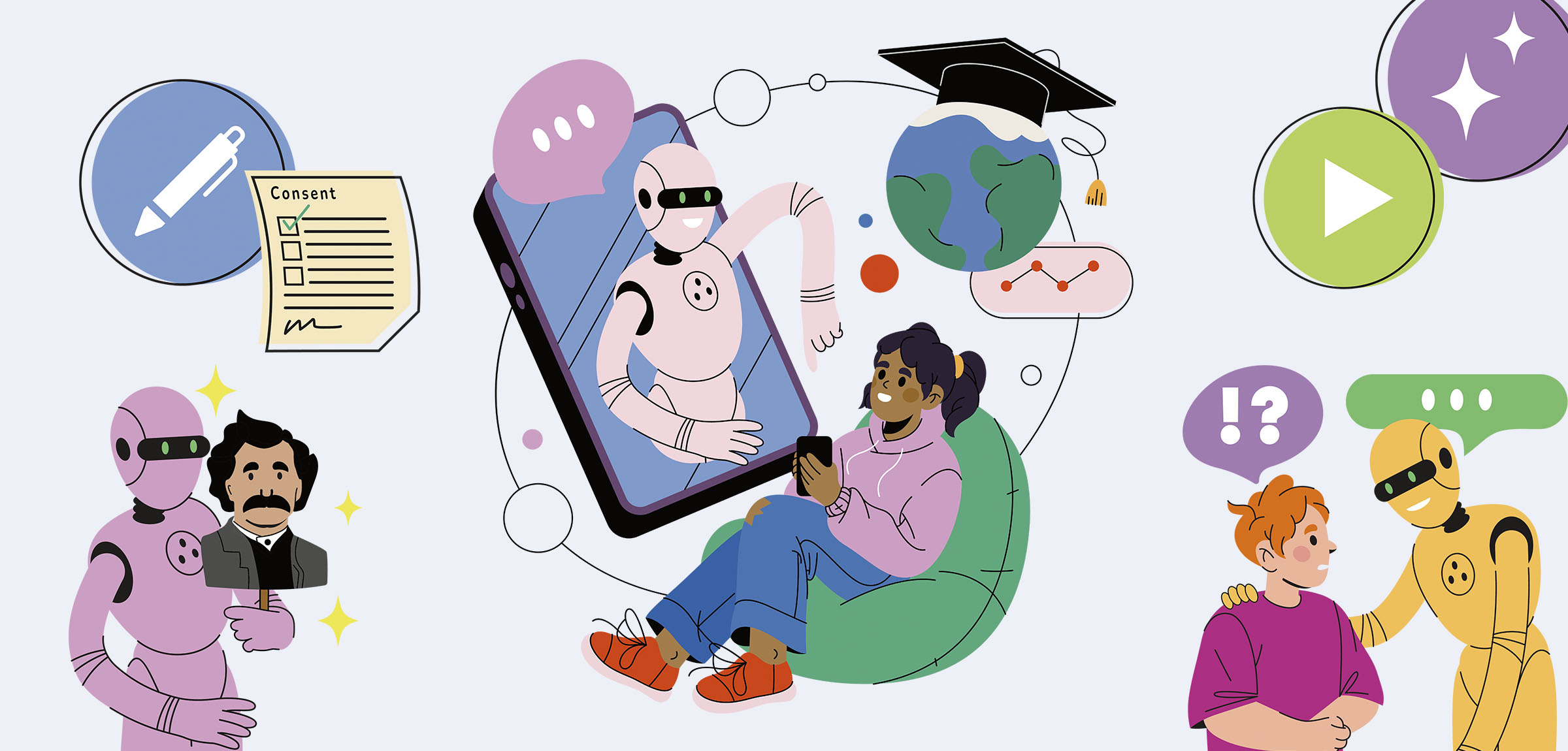
In May 2026, with the rising use of anthropomorphic AI systems designed to replicate human characteristics, delegates at the Annual Representative Assembly of the Alberta Teachers’ Association adopted three AI-related policies, as summarized below. Beware of false friends. Be historically accurate. Be true to the living. |
Alberta leadership, Canadian action
This advocacy did not end in Alberta in the spring. The Association’s leadership on Provincial Executive Council carried it onto the national stage through the Canadian Teachers’ Federation’s annual general meeting in July 2026, at which teachers from across the country voted to establish the same ethical boundaries for AI companions and for simulations of historical figures and living people. Together, these positions mark a historic first for the teaching profession and offer a principled Canadian response to technologies that are moving much faster than public policy and general awareness.
Alberta teachers are leading because they acted before technology companies sell these systems to school jurisdictions and they become normalized. Teachers did not wait for widespread deployment or obvious harm. They distinguished useful AI from technologies that exploit human trust, and they translated professional concern into practical policy and, in doing so, took that leadership across Canada.
From Alberta’s representative assembly to the national federation’s general meeting, teachers have asserted that professional judgment must guide the use of emerging technologies. The decisions made now will shape the human boundaries of education for years to come, not only in Alberta and Canada but for teachers and school leaders around the world.
Students deserve genuine human connection. They deserve caring adults, supportive peers, trusted school counsellors and, above all, the irreplaceable presence of a human teacher. Alberta teachers drew that line. Canadian teachers affirmed it. Now education systems everywhere have an example and can follow their lead.
Recommended resources
In May 2026, with the rising use of anthropomorphic AI systems designed to replicate human characteristics, delegates at the Annual Representative Assembly of the Alberta Teachers’ Association adopted three AI-related policies, as summarized below.
Videos
How AI is reshaping what it means to be human Attachment hacking: AI’s race to artificial intimacy
Human Change Foundation
Article
5 lessons from teachers on the risks of anthropomorphic AI An interview with the ATA’s Phil McRae