
ATA Leaders address delegates at Annual Representative Assembly
President Schilling and Executive Secretary Theobald deliver their annual speeches to teacher representatives from across the province.
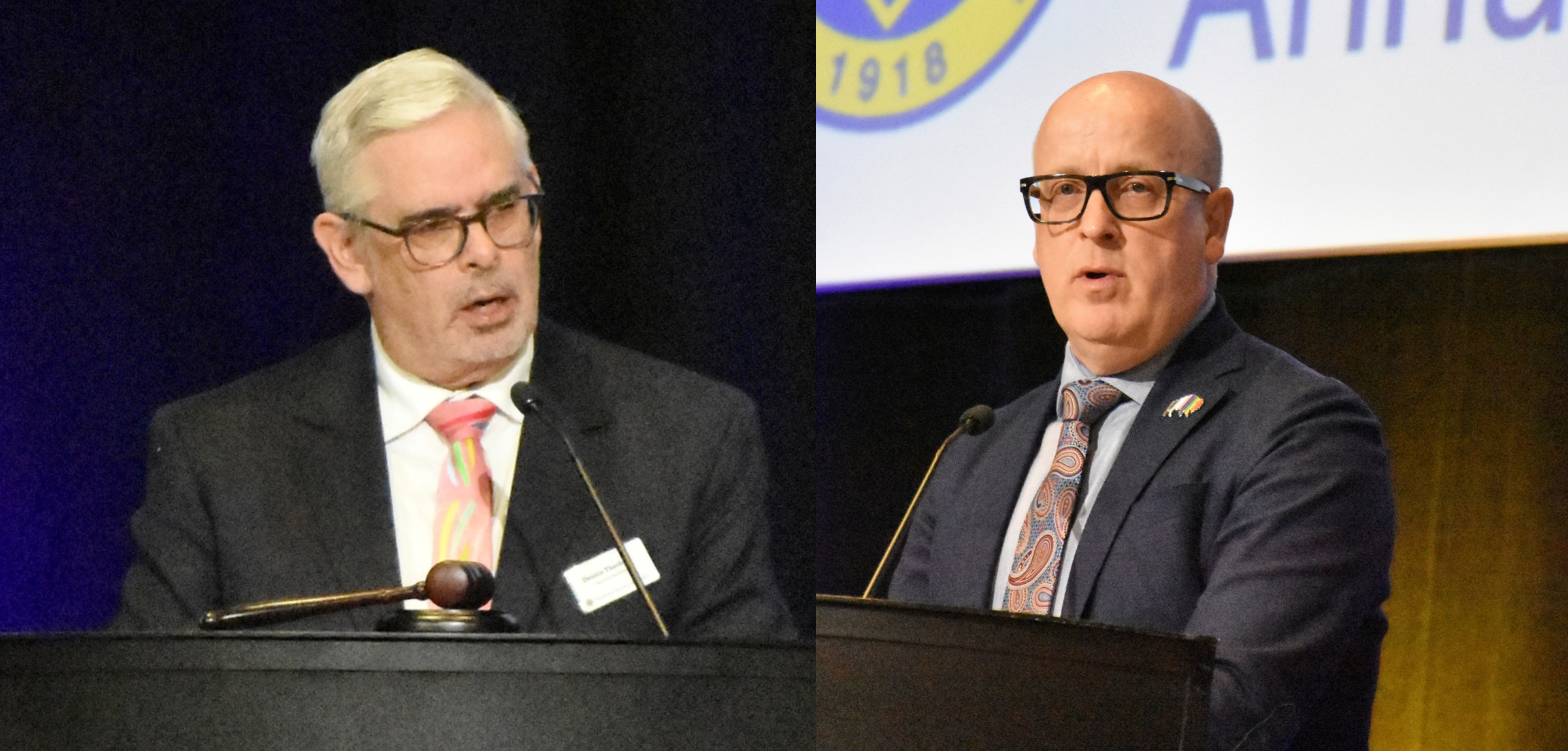
ATA President Jason Schilling
ATA Executive Secretary Dennis Theobald
Full text
President Schilling's speech
President Schilling's speech
Colleagues,
Thank you to Elder Doreen Bergum for starting us off in a good way. To our award winners, thank you for your dedication, energy and unwavering devotion to equality and public education. To our members gathered here today, thank you for your commitment on behalf of your colleagues.
When the pressure is high and difficult decisions must be made, especially during a tough and challenging year for teachers marked by a strike, I have always relied on the values that brought me to teaching and to this Association in the first place—values shaped by my parents, my teachers, my colleagues, and all of you—and, as leaders, our responsibility in those moments is to cut through the noise, the anger, the threats, and the distractions that so often try to shake our foundation.
Colleagues, before we talk about policy, conflict, or politics, I want us to remember where this all begins, where it all starts.
My classroom. Early morning light shining through the windows stretching across the floor. Standing at the door. Students arriving—some eager, some distracted, some carrying burdens that I will never truly see.
And still, I got to work and taught.
Not because it was easy.
Not because the conditions were ideal.
But because of what I believe.
A belief of honesty, in justice.
A belief that I can make a difference.
A belief shared by everyone in this room today.
Together, we believe that public education is a public good—and that every child, no matter who they are or where they come from, deserves a safe place in our classrooms regardless of the politics of the day.
That is where the Alberta Teachers’ Association truly begins. Not in this ballroom, but in those classrooms.
Do not get me wrong, this assembly matters. Here, 51,000 voices come together to decide what we will stand for—and how we will stand together. We are a public institution with credibility, expertise, and the democratic legitimacy to shape Alberta's future.
Before I go any further, it is important to pause and acknowledge something fundamental … and truly remarkable.
During the strike, teachers stood unified in their beliefs, and they should be intensely proud of that stance.
I want to extend my next words of gratitude to not only the delegates in this room, but across the entire province, from High Level to Milk River, from Lloydminster to Jasper. Thank you.
To our ATA Locals, Provincial Executive Council and ATA staff: you carried the weight of uncertainty while continuing to lead with care, clarity, and integrity. You stood by teachers—steadfast, principled, and committed to strengthening public education. That support mattered. It still does. Thank you.
We also learned that teachers and school leaders did not stand alone. There were parents and community members who stood alongside us, asking thoughtful and challenging questions while continuing to advocate for and trust in the profession.
Students demonstrated patience, resilience, and understanding well beyond their years. The broader community, some of whom are with us in this assembly today, reminded us that public education matters and that teachers are valued. For all these groups, I am deeply grateful.
Because what we are part of, this community, this Association, is bigger than any one of us. As an Association we should be proud of our diversity, our strength and our values. When it mattered most, teachers showed up and stood up.
Now, let’s name something honestly.
Deciding what to write for this year’s address has been very challenging, just like the year we have experienced. The challenge is how to convey the intermix of anger and hope. Of disappointment and pride. Of wanting to learn from the past while managing the expectations of the future.
Bringing together 51,000 teachers and school leaders with different experiences, perspectives, and realities is not easy work. Though we may be driven by similar values, we are not the same.
Some teach in communities growing faster than resources and funding can keep up. Some are holding together programs where every decision involves trade-offs. Some are early in their careers, still finding their footing. Others have spent decades in this profession and have witnessed profound change.
Different realities. Same profession.
And within that shared reality, within the small joys of our classrooms, there is also anger.
Anger at classrooms that are stretched beyond capacity.
Anger at supports that fall short of the complex needs in front of us.
Anger at decisions about education made by government or school boards without the voice of the profession.
Anger that we should not have to fight this hard to get what our students, classrooms or the profession deserves.
At times, that frustration understandably turns inward—toward each other, toward differences in strategy, toward conflicting views about how best to move forward.
That tension is real; it is the price of caring deeply about the profession we love.
The history of teachers in Alberta—most recently our strike—reminds us of something essential: when pressure builds long enough, teachers do not retreat.
We organize.
We act.
And we are heard.
The Strike of 2025 reminded this province what happens when teachers refuse to acquiesce.
Whatever perspective we bring to that moment, whatever complex emotions we carry—anger, frustration, disappointment, pride—it left us with a truth we cannot afford to forget:
We are strongest when we act together.
And we are weakest if we turn on each other.
That is the balance before us now. We have demonstrated our commitment to public education and to each other. Now comes the work of listening, reflecting and making changes that will move us forward.
This means renewing our commitment to defending a public education system that serves every student especially those that deserve to have their learning needs met without question. It means to remember what we value.
Equity and inclusion--insisting on conditions where all students and all teachers can succeed.
Teacher voice and collective action knowing we do not stand alone when decisions affect our work and our students.
Professionalism means applying our best judgment, even when circumstances challenge it. This means we must continue defending against efforts to undermine the profession.
Justice and advocacy mean speaking up—even when silence would be easier.
Collegiality, supporting one another—not only when we agree, but especially when we do not.
Democracy means every voice matters, and no single voice outweighs the collective.
Integrity means acting with honesty, even when moments are difficult.
These values do not disappear when times are hard.
They are tested.
They are not just words.
They are a responsibility.
These values guide our decisions, our conduct, and the choices we make together especially when it is hard.
So what do we do with the anger?
We do not ignore it. We learn from it.
We do not minimize it. We acknowledge it.
And we do not turn it inward.
We discipline it.
We direct it outward—into advocacy.
We turn it into clarity about what our students and teachers need.
We make it fuel our resolve about the kind of profession we are determined to be.
But anger alone is not enough.
We must pair it with resilient hope.
Not the kind of hope where we pretend everything is fine—but the kind teachers practice every day. The hope that tries again after a hard lesson. The hope that sees possibility where others see limitation. The hope that refuses to give up on students and ourselves even when the system makes it harder than it should be.
That same hope must live here.
Because the challenges facing public education are not easing.
Today, we mark 200 days since we were stripped of our charter rights. Let’s be perfectly clear, I condemn the government in its use of the notwithstanding clause against teachers and how they rammed it through the legislature in one night. It is not the governance our province deserves.
I would encourage you, as an act of solidarity, to post the social media graphic found in the ARA shared folder to remind all Albertans of the actions the government took 200 days ago.
Since that dark day, we have experienced what many call a flooding of the zone since the Legislature started sitting last October.
Besides our already growing class sizes, increasing complex student needs, a decade of chronic underfunding, regulations that punch down on trans kids, and bizarre battle with a Canadian literature icon about book bans in the summer of 2025.
Alberta's teachers and students have also endured a policy environment that too often treats education as a cost rather than an investment. Bill 2, Bill 6, Bill 9, Bill 13, Bill 25, complexity teams, revamped budget formulas, increased private school funding, public dollars to private buildings, curriculum, assessment, and now, I fear, we will be dealing with a flood of disinformation on separatism which will creep into our schools even though the government will unrealistically expect teachers to not talk about it.
These pressures are real—and they are ongoing.
Colleagues, we cannot meet these challenges divided.
Division does not strengthen public education. It weakens it.
It does not elevate the profession. It diminishes it.
And the only people who benefit are those who want to divide us and undermine public education.
We must not give them an inch.
The question before us is not whether we will disagree.
We will.
The question is how we move forward.
For individuals, it means supporting colleagues—even when their circumstances differ from your own.
For teachers as a collective, it means to continue to build bridges, so no member feels isolated or unheard.
For the provincial Association, it means listening, holding space for our member’s diversity while also holding firm to our values that ensure every member can see themselves in the path forward.
And for all of us, it means remembering that solidarity does not mean sameness. It means to take our power back together.
And honestly, it is a decision.
A decision to stand together when fragmentation would be easier.
A decision to trust our democratic process, even when it is imperfect.
A decision to believe that 51,000 teachers, acting collectively, can shape the future of public education in this province.
Because we can—and because we already have.
The strike was not just symbolic, it resulted in real change. It altered political decisions, shifted public opinion, and reasserted teacher voice. That power did not disappear.
Since the strike, government officials, including the premier and the minister of education, have openly acknowledged that decisions were made because teachers and the public demanded change. That is what collective action does. It works.
We exercise that power every day in classrooms across Alberta.
So, as we begin this Assembly, bring your voice.
Bring your ideas.
Bring your frustration.
But also bring your commitment to one another and conviction to make things better.
Because what we build here might not be perfect. No person and no organization is.
But it must be united.
It must be grounded in the values that brought us into this profession in the first place.
That is how we honour our past.
That is how we meet this moment.
That is how our shared purpose and message will resonate far beyond these walls.
And that is how we build a future worthy of the students and families we serve.
Because, you see, on Tuesday morning, teachers across this province will walk back into their classrooms. They will stand once again at classroom doors.
They will greet students carrying excitement, uncertainty, curiosity, grief and possibility.
They will return to classrooms that are under resourced. To students whose needs continue to grow. To work that is too frequently misunderstood by those furthest from it.
And they will teach.
They will stay late helping a struggling student.
They will calm fears.
They will spark curiosity.
They will create belonging.
They will do what teachers have always done: show up.
Not because it is easy.
Not because the conditions are perfect.
But because they believe public education matters.
As teachers return, they must know something.
They must know that they do not stand alone.
Not in Edmonton. Not in Calgary. Not in Fort McMurray or Medicine Hat.
Not in rural schools or growing urban classrooms.
51 000 colleagues stand with them shoulder to shoulder.
That is the power of THIS Association.
That is the meaning of solidarity.
Not sameness. Not uniformity. But a shared commitment to one another, this profession, and to every student who enters our classrooms.
Let this Assembly be remembered not only for the debates we had or the challenges we faced, but for the choices we collectively make.
To listen.
To stay united.
To defend public education and each other.
And to keep building a future worthy of the students and families we serve.
Colleagues, the work continues. We know who we are, what we stand for, what we value, and when we stand together, we stand stronger.
Thank you.
Executive Secretary Theobald Speech
Executive Secretary Theobald Speech
Colleagues, delegates, and friends,
Thank you for the opportunity to speak with you—one final time in this role—and thank you for the work you bring to this Assembly. What happens here matters. It matters not only for the year ahead, but for the long‑term health of this Association and the profession it serves.
Much has already been said—rightly—about the pressures of the past year: the political pressure, the intensity of labour conflict, the strain on teachers and school leaders, and the weight of continuing to serve students under increasingly difficult conditions. Those experiences deserve to be named and framed, and the President has done so with clarity and conviction.
What I would like to do this afternoon is step back and through the lens of my own tenure as Executive Secretary speak about the Association itself—how it has functioned, how it has adapted, and how it has endured across a period of sustained pressure that extends well beyond the past year.
Because resilience is not only about resolve in moments of crisis. It is about whether institutions are built in ways that allow people to act collectively over time—without losing purpose, legitimacy, or trust.
Let me speak first about the changing environment of our work as teachers and as an Association.
When I took on the role of Executive Secretary over eight years ago, the Alberta Teachers’ Association was already operating in a challenging policy environment. But even then, few would have predicted the extent or pace of change that would follow. It seems that everything has been happening, everywhere and all at once.
A defining point early in my tenure was the election in 2019 of a new United Conservative provincial government with a clearly articulated plan to reshape public education in Alberta. That plan emphasized its particular vision of extended parental choice, expansion of charter and private schools, adoption of a perennialist curriculum that promoted a narrowed vision of learning, and a redefinition of the respective roles of government, school authorities, and the teaching profession that centralized power with government.
However, just as this project was getting underway, the global pandemic disrupted nearly every aspect of our lives and of public education—the social, political and cultural impacts of that singular event persist to this day. For teachers and school leaders, COVID‑19 was not only a public‑health crisis, it was a system‑wide stress test that required teachers to shift rapidly between in‑person, remote, and hybrid forms of learning. Teachers adapted instruction, curriculum, assessment, and pedagogy in real time, often with limited guidance and in conditions of considerable uncertainty. For the Association, the pandemic posed the challenge of maintaining service to members, governance and advocacy.
While the pandemic temporarily disrupted and mitigated the grand plans that the Kenney government originally had for education, the general direction of its policy remained unchanged. In the years that followed, those directions were translated into legislation, policy, and funding decisions that fundamentally altered the landscape in which the Association operates. The removal of caps on charter schools, increased public investment in private schools, and changes to the funding framework fundamentally shifted the structure of the broader education system.
At the same time, curriculum development processes were centralized within government, and long‑established collaborative relationships with the profession were significantly reduced. For the Association, this marked the beginning of a period in which it would increasingly be required to operate in a more directive and less collaborative policy environment, while continuing to uphold its responsibility to advance public education and represent its members.
Most recently, we have seen government actively promoting its own ideological priorities in the classroom through the introduction of legislation affecting the ability of schools to recognize, welcome and support vulnerable trans and gender/relationship‑diverse students. Tied to this has been intrusive school library policy, and various efforts to diminish teachers’ professional judgment and status. Each one of these interventions being framed as a response to some ginned-up crisis.
Focusing now on the Association itself, government inserted itself into the democratic government of the province’s unions though Bill 32, an act that sought to constrain unions’ capacity to engage in public‑interest advocacy and support allied social groups and organizations within Alberta and across the country. The Association responded by establishing a Defense and Advocacy Fund using legacy resources and continued to fulfill our broad legislated mandate in accordance with the direction provided by the representatives attending this Assembly.
But perhaps the most significant structural change for this organization itself came with the removal of its long‑standing responsibility for professional self‑regulation.
For eighty-five years, the Alberta Teachers’ Association had a unique role and status in Canada. It was not only a bargaining agent, it was also the body responsible for upholding standards of professional conduct and competence. Through this Association’s professional conduct and practice review processes, teachers governed themselves—establishing, applying, and maintaining standards grounded in professional knowledge, collegial accountability and a commitment to maintaining public trust.
With Bill 15, authority over professional discipline was transferred from the profession to the Ministry of Education. This was no minor administrative change. It altered the fundamental nature of the Association itself. It required a redefinition of role—from regulator and self-governing profession to an organization focused more directly on advising, supporting, and protecting members within a system of external regulation.
And while all this has been going on, teachers and students continued to bear from day to day the brunt of chronic underfunding of schools exacerbated by rapid enrolment growth. Teachers watched governments adopt Band-Aide solutions such as fiddling funding models while discontinuing the collection of inconvenient class size and complexity data. But this “ostrich policy” fooled no one. Albertans, informed by the Association’s continuing advocacy in media and conversations with teachers in their own communities were well aware that our schools were the least funded in the country and that teaching and learning conditions were deteriorating to the point of crisis, a crisis that culminated in our labour action of October 2025. That labour action and government’s decision to impose a settlement by legislation, casually buttressed by the most regressive provision of the Canadian Charter of Rights and Freedoms, the notwithstanding clause, has left an indelible mark upon teachers individually and collectively.
All this context matters, not as a catalogue of complaints and injuries, but because it explains the scale of what the Association has been required to do in response.
Having spoken of change, let me turn now to that response and our commitment to maintaining continuity and integrity.
Throughout this eight-year period—and despite the immediate challenges it has faced—the Alberta Teachers’ Association has not narrowed its work or lost sight of its larger mission.
The Association has continued to uphold standards of professional practice—through fostering professional learning, through leadership of the profession nationally and internationally, through research, through collaboration with faculties of education and through the ongoing work of supporting teachers in meeting the expectations of their profession.
The delivery of professional learning opportunities has expanded to include new virtual delivery formats and to address emerging issues and trends affecting education. Tens of thousands of teachers continue to engage in professional learning led by Association staff and dedicated members of our various PD cores while convention and specialist council work continue thanks to the hard work of teacher volunteers. Beginning teachers are welcomed and mentored. Substitute teachers and school leaders are supported in their unique and vital roles.
So too, the Association’s support for diversity, equity and inclusion despite government and other institutions stepping away from this work. Diversity and Equity Networks to support racialized teachers, gender and relationship‑diverse teachers, and teachers with disabilities have been inaugurated. I am particularly proud of ongoing expansion of our initiatives to uphold our commitment to the calls to action of the Truth and Reconciliation Commission.
Our collective experience over the last eight years reinforces something fundamental— that strong public education depends on confident, well‑supported professionals who learn together.
The Association’s internal capacity to serve and protect teacher-members in matters relating to their employment resides in Teacher Employment and Member Services and in Regulatory Affairs. Over the course of the last eight years, demand for expert advice, representation, and support have increased significantly. Many more of our members require assistance navigating employment concerns, evaluation, accommodations, collective bargaining and professional conduct processes within the new regulatory environment. To more effectively and efficiently respond to demand, the Association has reorganized the provision of services and greatly expanded the capacity of the Southern Alberta Regional Office.
Of course, our ability to support collective bargaining is front of mind for everyone in this room and subject to what, I believe, will be constructive scrutiny. There are lessons to be learned from this most recent round of bargaining and we will learn and act on them. But let us also be clear; the circumstances leading to the imposition of a settlement by legislation and the manner in which that was done were utterly without historical precedent. That said, despite our frustrations and disappointments, we are seeing some early promise of progress towards addressing class size, complexity and the issue of aggression in schools. This is not the result of political good will or some sudden enlightenment on the part of government, but a response to the unrelenting political pressure exerted by teachers through their advocacy and the resolve they demonstrated by a labour action of unparalleled scale.
Finally, the past years have also highlighted the importance of good governance.
The practice of democracy is never easy and the Annual Representative Assemblies, Provincial Executive Council, Association committees and locals have not balked from taking upon themselves responsibility for making the tough decisions demanded by tough times. The Association, in its various parts and dimensions has established policy, approved programming and set budgets, all the while ensuring that the direction of its efforts remained grounded in voice of its members.
At a time when political discourse is increasingly toxic, those who have taken on leadership roles are subject to overwhelming pressure. I single out here the members of Council, table officers and the president whose commitment to serving you has been unwavering and demonstrated courage and integrity.
While some of the work the Association does is very visible and well known to you in this room, much of the Association’s success is founded on the invisible efforts or staff in Edmonton and Calgary who inform and operationalize the decisions made by elected leaders. The members of executive, support and professional staff each bring their unique talents, energy and commitment to ensuring continuity, accountability, and effective service to members. Their work, often uncelebrated, is essential and the foundation of the Association’s value to its members.
Throughout my tenure, the Alberta Teachers’ Association has been required to adapt repeatedly. It has lost roles it once held and changed in ways welcomed and unwelcomed, planned and unplanned. It has navigated a policy environment that has become more centralized and more contested. It has had to respond to economic constraints and challenges.
And yet, despite all of this, it has endured and remains a coherent, democratic, member‑directed professional organization.
That endurance is not accidental. It is the result of sustained effort by teachers who continue to build and govern this institution.
Institutions matter because they carry memory forward. They allow learning to accumulate. They ensure continuity in the face of change.
As I conclude my eight years as Executive Secretary, and twenty‑five years on Association staff, I do so with confidence—not because the challenges ahead are small, but because the capacity of this organization to meet them is real and substantial.
The Alberta Teachers’ Association has changed—but it has not been diminished. It has adapted. It has endured. And it remains grounded in its purpose.
It has been an honour to serve this Association and this profession along side its dedicated Executive, Professional and Support staff and I am pleased to have my friend and colleague Robert Mazzotta step into my role as I step away.
Thank you for your trust. Thank you for your work. And thank you for carrying this organization and this profession forward.